Keeping a kiryana store's accounts (hisaab) day by day
A kiryana store's hisaab comes down to six questions: what was sold, whether the drawer is right, who owes you, whom you owe, what the shop spent and what it earned. A daily routine that answers them, and how MartPOS keeps each figure as the counter works.
Most kiryana shops keep their hisaab in three places: a sale register, a khata copy and a diary of what was spent, with the rest in the owner's head. At the end of the month the three rarely agree with the cash, and nobody can say whether the shop made money or only turned stock into udhaar. The accounts of a kiryana store are simpler than they look. They come down to six questions, asked every day. This guide sets out a daily routine that answers them, and shows where MartPOS keeps each figure, because it writes them down as the counter works rather than as a separate job at night.
The six questions a shop's hisaab answers
| Question | Where the answer comes from | Where MartPOS shows it |
|---|---|---|
| What did we sell today? | Every bill, less returns and discounts | Reports › Daily: net sales, returns, discounts |
| Is the cash in the drawer right? | Opening cash, cash bills, refunds, cash paid out | The shift close: counted, expected and the difference |
| Who owes us? | Bills on udhaar, less what customers paid | Khata: Udhaar to collect, each statement, Ageing |
| Whom do we owe? | Supplier bills on credit, less payments | Supplier statements, Ageing › Suppliers |
| What did the shop spend? | Rent, wages, electricity, transport, tea | Expenses, by what they were for |
| Did we make money? | Sales, less the cost of what was sold, less expenses | Reports › Profit and loss |
If you can answer these six every evening, the month takes care of itself.
Why a register rarely balances
A register goes wrong in small, ordinary ways. A bill on udhaar is written as a cash sale because the customer "will pay tomorrow". A khata payment received in cash goes into the drawer but not into any copy. An expense is paid from the drawer, a rickshaw for a delivery or the milk for tea, and never written down. Each one is small; together they make the drawer short, the udhaar wrong and the profit a guess.
Software helps only if it removes those gaps, not if it becomes a fourth copy. In MartPOS every document writes both sides of what happened at the moment it is saved. A bill paid in cash adds to sales and to the cash expected in the drawer; a bill on khata adds to sales and to what that customer owes; an expense from the drawer takes cash out of what the drawer should hold. That is double entry, and it is why the figures agree without anyone adding them up.
A daily routine
- Open the shift with a count. Count the cash already in the drawer and type it as the opening float. Everything that moves cash through the drawer is added to it until the close. See shifts and closing the day.
- Bill everything at the till, udhaar included. When a regular customer takes goods on credit, choose them on the bill and put the unpaid part on their khata. Never "write it later": later is when it gets lost.
- Take khata payments on the Khata screen. A payment received there in cash goes into the drawer's expected figure, and the customer's balance drops at once, with a numbered receipt.
- Record every expense when it is paid, from the drawer, the bank or a wallet, with what it was for. A supplier's bill for goods is a purchase, not an expense. See expenses and cash to the bank.
- Count the drawer blind at closing. The cashier counts the notes first and only then sees what MartPOS expected. A difference is recorded as cash over or short, not hidden.
- Read the daily report. Net sales, gross profit, returns, discounts given, and the bills by how they were paid: cash, card, bank, EasyPaisa, JazzCash, on khata and from advances.
Once a week, look at Ageing for customers and suppliers: who owes you, whom you owe, and for how long. Once a month, read the Profit and loss for the month, and when your accountant has finished with it, the owner can close the books through that date so nothing is posted into it by mistake.
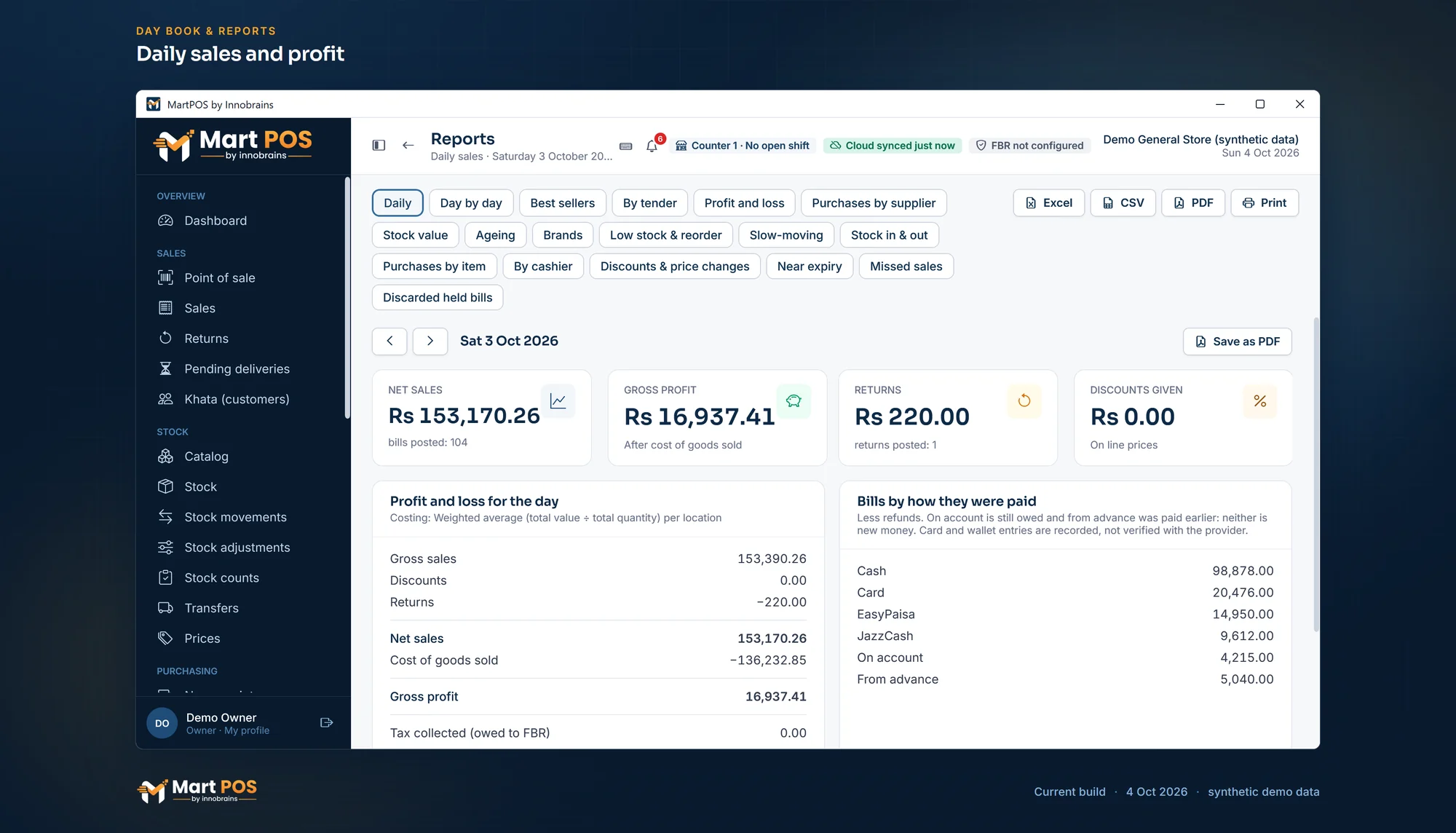
Daily sales and profit. Net sales, gross profit, returns and discounts for the day, the day's profit and loss, and bills by how they were paid. Screenshot of the current build (4 Oct 2026), synthetic demo data.
The day book, or roznamcha
The day book is the shop's roznamcha: every entry of every day, in order. In MartPOS you never type into it; you read it. A cash bill, for example, debits Cash in hand and credits Sales, and in a second pair of lines moves the cost of the goods from Inventory to Cost of goods sold at the item's average cost. The trial balance lists every account with its balance, and its two totals are always equal, because an entry that does not balance is never written.
Accounts & books shows the same postings the way an accountant reads them: a cash book for each place money is kept (the drawer, the bank, EasyPaisa, JazzCash), ledgers for any account, and a balance sheet. Each can be saved as CSV for Excel or as a PDF. See the day book, trial balance and closing the books.
Sales are not profit
The number that matters is not what you sold but what you kept. Gross profit is sales less the cost of the items sold, at their weighted-average cost. Stock bought this month but still on the shelf is not a cost yet: it sits in the stock value. Take the expenses away from gross profit and you have the month's net profit, which is what Profit and loss shows for any dates you choose.
Two things are not income, and MartPOS keeps them apart: an advance a customer pays ahead, which is money you owe them until they take goods, and tax charged on a bill, which the shop owes, not earns. See reports for the owner.
Udhaar given and udhaar recovered
A bill on khata is a sale on the day it is made; the payment later only settles the account. So a busy day with a lot of udhaar can show good sales and a thin drawer, and that is correct. The daily report shows how much of the day went on khata, the Khata screen shows the total udhaar to collect, and each customer's statement shows every bill and payment with a running balance. For the habits that keep udhaar healthy, see udhaar khata for customers, and for the screens, khata: customers, credit limits and recoveries.
What MartPOS does not do for your accounts
- Tax decisions. MartPOS adds the tax rate you set on each item; it does not choose rates. Ask your tax adviser.
- Your own accounts. The chart of accounts is fixed: MartPOS posts to it itself, and accounts cannot be added or renamed.
- Chasing payments. The ageing report tells you who owes what and for how long; the phone call to the customer is yours.
- Your accountant's work. MartPOS keeps the books as the counter works, but your accountant still reads them, prepares your returns and tells you when a month is ready to be closed.
Common questions
Do I still need a register?
No, if every bill, payment and expense goes through MartPOS. Many owners keep a small diary for the first weeks to compare; once the daily report and the drawer agree day after day, the diary can go.
Can my accountant use the figures?
Yes. The day book, ledgers, trial balance and balance sheet can be saved as CSV or PDF for any dates, and the accountant can read the balances straight into their own books.
Is a bill on khata counted in today's sales?
Yes. It is a sale on the day it is made. The payment that comes later settles the customer's account and adds to the drawer if it is paid in cash, but it is not a new sale.
What if the drawer is short at closing?
The difference is recorded as cash short, with the shift, the cashier and the counter, so it shows in the profit and loss. Check the refunds, payments and expenses paid from the drawer that day first: a cash payment recorded as JazzCash, or the other way round, is the usual cause.
Can I see the day's sales from home?
Yes, once the store PC is paired with MartPOS Cloud: the owner portal shows each branch's daily sales, expenses and khata read-only, always with the time the branch last reported. See the kiryana store software page for everything MartPOS does for a kiryana shop, or the udhaar khata page for credit and payables.
Founder & CEO, Innobrains Technologies
Arshad Ali is the founder and CEO of Innobrains Technologies, the company that is building MartPOS: point-of-sale, stock and khata software for kiryana stores, general stores and mini marts in Pakistan.
Run your shop on MartPOS
Barcode billing, loose goods and packs, khata and advances, on the shop's own PC without internet. We set it up on your shop PC with you.
Related guides
Wholesale and retail prices in one shop, without mistakes at the counter
Many kiryana and general stores sell thok and parchoon from the same shelves. How to give every unit a retail and a wholesale price, decide who pays which, keep the switch out of the wrong hands, and see what wholesale really sells, with the way MartPOS does it.
30 Sep 2026 · 7 minUdhaar khata for customers, without losing track of who owes what
Khata keeps a neighbourhood shop's regulars coming back, and quietly eats its cash if nobody watches it. How to set credit limits, sell on khata, take payments, read a statement and chase what is overdue, with the way MartPOS keeps each account.
29 Sep 2026 · 5 minUrdu on your shop's receipts: the words, the item names and what to check first
Many customers read Urdu more easily than English, and the names they ask for are Urdu names. What a receipt can show in Urdu, how a thermal printer prints Nastaliq, how to choose between Urdu, English or both, and what to test before relying on it.
04 Oct 2026 · 6 min