Udhaar khata for customers, without losing track of who owes what
Khata keeps a neighbourhood shop's regulars coming back, and quietly eats its cash if nobody watches it. How to set credit limits, sell on khata, take payments, read a statement and chase what is overdue, with the way MartPOS keeps each account.
Khata keeps a neighbourhood shop's regulars coming back. The family that settles at the start of the month, the hotel that pays every Friday, the smaller shop that buys at your wholesale rate: all of them buy on credit because you know them. Kept in a copy, khata works until the day a page is torn, two people write in it at once, or a customer says "I paid you last week" and nobody can prove it either way. This guide covers the habits that keep khata healthy, and how MartPOS keeps each account.
Decide the limit before the first bill
The most useful number on a customer's account is their credit limit: the most they may owe you at any time. Set it when you add the customer, not when the balance has already grown too large to question.
- No limit means cash only. In MartPOS a customer with no credit limit cannot buy on khata at all. That is the safe default for a new face.
- Start small and raise it. A limit is easier to raise after three months of good payment than to cut after one bad month.
- Write down the terms. An optional number of days to pay, for example 30, and a note such as "pays at month end" help whoever is at the counter.
When a bill on khata would take a customer over their limit, MartPOS refuses it and says by how much. The cashier can take part of the bill in cash, or a manager can raise the limit first.
Selling on khata
At the till, choose the customer (F4 searches by name or phone) and, when taking payment, put the unpaid part on the customer's account. The rest can be paid in cash, card, bank transfer, EasyPaisa or JazzCash in the same bill. A bill on khata counts as a sale on the day it is made; the payment later only settles the account.
Taking a payment
Choose the customer, then Receive payment. The amount starts as what they owe; change it if they pay part. Cash goes into the drawer of the counter that took it and is counted at the shift close; bank, card and wallet payments do not touch the drawer. Each payment gets a number, and the new balance is shown at once.
Payments settle the oldest unpaid bills first, so the list of unpaid bills always shows what has really been outstanding longest.
Advances are not khata
Some customers pay ahead: a family leaves money for the month's groceries, a canteen pays in advance for a regular order. That money belongs to the customer until they take goods for it, so MartPOS keeps it apart as an advance. It is not counted as a sale or as extra cash. Later bills can be paid "From advance", alone or with cash, and what is left can be refunded. An advance never reduces what the customer owes on khata by itself; the two are shown side by side.
Read the statement, share the statement
Every customer's statement lists each bill, each payment and each return with a running balance, for any dates you choose. With it you can answer "I paid you last week" in a few seconds: the payment is there with its number, or it is not. A statement can be saved as a PDF to send on WhatsApp or printed on A4.
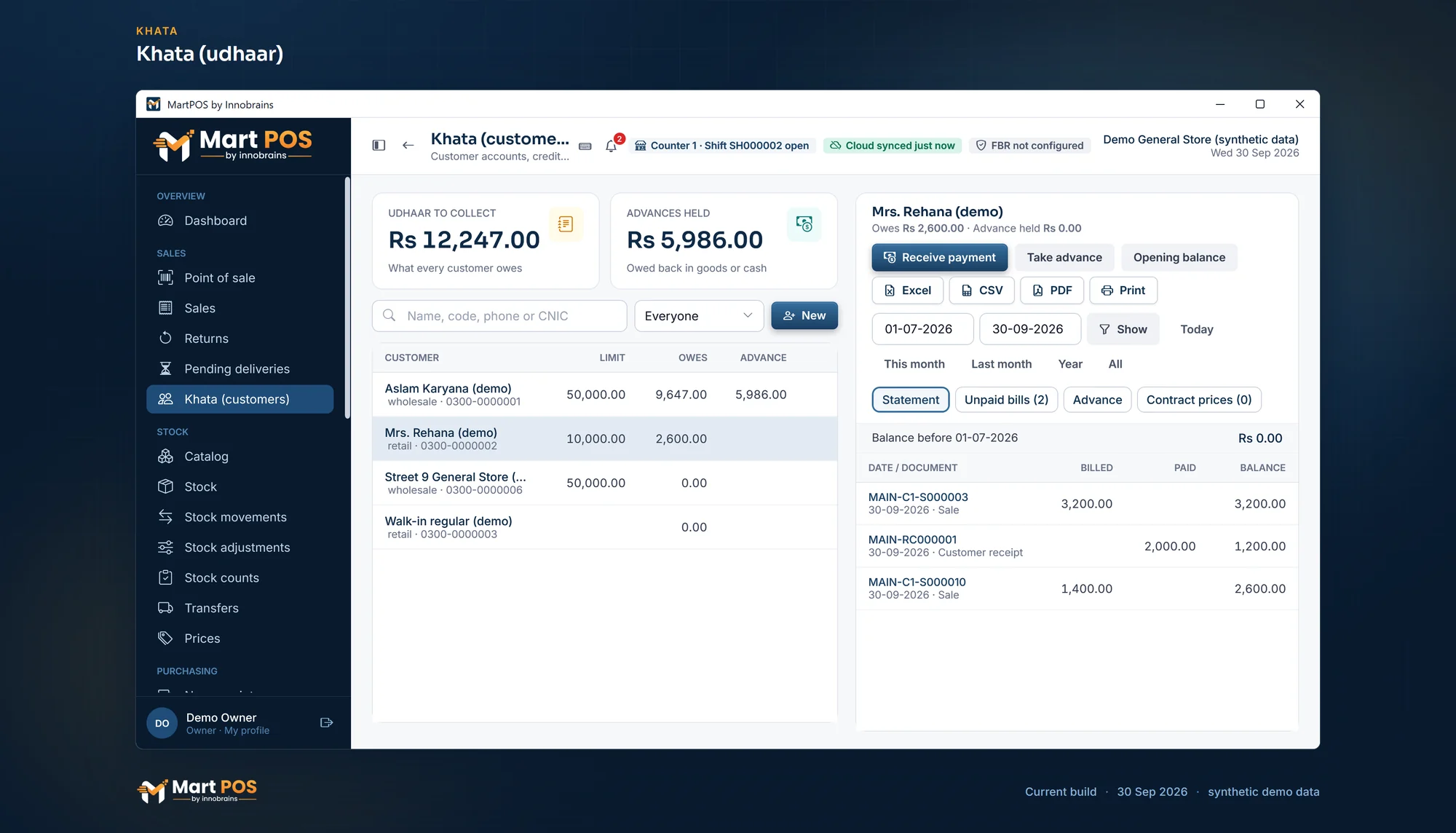
Khata (udhaar). What each customer owes on khata, their credit limit and advance, and a statement of bills and payments for any dates. Screenshot of the current build (30 Sep 2026), synthetic demo data.
Chase what is overdue
The ageing report groups what customers owe by how long it has been owed: up to 30 days, 31 to 60, 61 to 90 and over 90. A balance that keeps moving into the older columns needs a phone call, and perhaps a lower limit. Look at it once a week, call the oldest balances first, and keep the customer's statement open while you talk, so every bill and payment is in front of you.
Wholesale buyers and agreed prices
Smaller shops that buy from you usually pay a different rate. A customer can be set to your wholesale prices, given a named price list, or given agreed prices for particular items, such as a restaurant's price for cooking oil by the tin. The till uses the right price whenever that customer is on the bill, and every bill line says where its price came from.
Suppliers are khata too
What you owe distributors and suppliers is kept the same way: purchases on credit, payments, advances paid ahead of a delivery, and a statement for each supplier. The same supplier bill number cannot be entered twice, which stops the most common double payment.
Common questions
Can a cashier give credit to anyone?
No. Only customers with a credit limit can buy on khata, and only up to that limit. Cashiers can find customers and take their payments, but creating customers and changing limits needs an owner, manager or accountant.
What about money customers owed before we started with MartPOS?
Enter it once as the customer's opening balance, dated with your first day, or import it with the customer list (moving your item list from Excel). It is not a sale and does not change that day's takings.
Can I see khata from home?
Yes, read-only. Khata is kept on the store PC; the owner portal's Khata page shows each branch's customer balances and postings as its store PC last sent them, with when it last reported.
Is each branch's khata separate?
Yes. Each branch keeps its own customers and their balances.
More on the udhaar khata page, and how the day's udhaar fits the shop's accounts in keeping a kiryana store's accounts. If khata is the heart of your shop, tell us how you run it.
Founder & CEO, Innobrains Technologies
Arshad Ali is the founder and CEO of Innobrains Technologies, the company that is building MartPOS: point-of-sale, stock and khata software for kiryana stores, general stores and mini marts in Pakistan.
Run your shop on MartPOS
Barcode billing, loose goods and packs, khata and advances, on the shop's own PC without internet. We set it up on your shop PC with you.
Related guides
Wholesale and retail prices in one shop, without mistakes at the counter
Many kiryana and general stores sell thok and parchoon from the same shelves. How to give every unit a retail and a wholesale price, decide who pays which, keep the switch out of the wrong hands, and see what wholesale really sells, with the way MartPOS does it.
30 Sep 2026 · 7 minKeeping a kiryana store's accounts (hisaab) day by day
A kiryana store's hisaab comes down to six questions: what was sold, whether the drawer is right, who owes you, whom you owe, what the shop spent and what it earned. A daily routine that answers them, and how MartPOS keeps each figure as the counter works.
30 Sep 2026 · 8 minLanded cost for kiryana purchases: freight and loading in the price of a bag
A bag of sugar does not cost what the mandi bill says. The truck, the loaders and the toll are part of its cost, and if they are not counted, every kilo looks more profitable than it is. What landed cost is, two ways to share it, and how MartPOS adds it to a purchase.
04 Oct 2026 · 7 min