FBR POS integration for small retailers: options and costs
Who has to report sales to FBR from the counter, what FBR POS integration involves, the ways to do it (software with it built in, a paid add-on, PRAL) and every cost to ask about, from the Re 1 service charge to the printer, with vendors' published prices checked on 7 October 2026. General information, not tax advice.
FBR POS integration connects a shop's billing software to FBR's computerised system, run by PRAL, so that every sale is reported to FBR as it is made. If your tax adviser has said your shop must do it, or you are buying a POS and want to be ready, this guide is about the choice: who has to integrate, the ways to do it, and what each one costs. What changes at the counter is in our other guide, FBR POS reporting for retailers.
It is general information, not tax advice. We read FBR's own documents on 7 October 2026 and link to each one, but the rules change with every budget and notification, so confirm your own position with FBR or your tax adviser before you spend money. We make MartPOS, whose FBR POS integration is optional and in every plan, so read our part with that in mind.
Who needs FBR POS integration
FBR requires it of retailers it classes as Tier-1, a term defined in section 2(43A) of the Sales Tax Act 1990. From 1 July 2026, after the Finance Act 2026, a retailer is Tier-1 if any one of these applies:
- it is a unit of a national or international chain of stores;
- it is in an air-conditioned shopping mall, plaza or centre (kiosks excluded);
- its electricity bills over the previous twelve months add up to more than Rs 1.2 million;
- it is a wholesaler-cum-retailer with a turnover of more than Rs 200 million, selling in bulk to other retailers and at retail to the public;
- its turnover in the previous twelve months was more than Rs 200 million, as declared or as worked back from the withholding tax deducted under sections 236G or 236H of the Income Tax Ordinance;
- it is in a class the Board prescribes. The Board may now also exclude a person or class by notification.
The Finance Act 2026 also removed two older tests: having a card machine from a bank or payment provider, and withholding tax under sections 236G or 236H above a limit the Board had set. If FBR has written to your shop under an old rule, do not stop on your own: ask your tax adviser.
What it involves, in short
- Registration. The outlet and each POS are registered with FBR, and each POS gets a POS ID.
- Each invoice reported. The software sends every invoice to FBR's system, receives FBR's own invoice number, and prints a QR code made from that number on the receipt (rule 150R(4) of the Sales Tax Rules). Customers can check a receipt in FBR's Tax Asaan app or by SMS to 9966.
- Two ways to reach FBR. FBR's Fiscal Component, a program from FBR installed on the POS computer, or FBR's online API over the internet.
- A service charge. FBR levies "service charges at a rate of Rupee one per invoice issued through integrated POS" (SRO 1279(I)/2021).
- Offline invoices. Invoices made while the internet or power is down are marked as issued in offline mode and uploaded within 24 hours of the connection returning (rule 150XC).
- Exempt items too. Invoices for exempt goods also go through the integrated system (rule 150R(9)).
Four ways to do it
Software with FBR reporting built in
The POS you bill with already knows how to talk to FBR. You register with FBR, enter the POS ID (and, for the online API, the access token) in its settings, test, and go live. This is often the simplest route when you are buying a POS anyway, as long as FBR reporting is in the price and not an add-on.
FBR reporting as a paid add-on
Some vendors sell their POS first and FBR reporting on top, as a one-time fee or a monthly charge. Add it to the price before comparing.
PRAL, FBR's own IT company
Under rule 150XF of the Sales Tax Rules, PRAL "shall provide free of cost integration services to the registered persons on demand", and must offer free downloadable POS software on FBR's website when the Board asks it to. Free integration does not make the rest free: you still need software that issues invoices, a PC and a printer. Whether PRAL's own software suits a shop like yours is for PRAL or FBR to tell you.
A firm that connects the software you already have
Since January 2025 (SRO 69(I)/2025, Chapter XIV of the Sales Tax Rules), integration through software is carried out by firms holding an integration licence under those rules, and PRAL acts as one by rule. If you like your current software and it has no FBR option, ask its vendor how it reaches FBR, and ask any outside firm what it charges, once and every year.
Costs to ask about
FBR's rules put the cost on the shop: "The cost for integration including the cost of equipment and electronic invoicing software or point of sales software shall be borne by the integrated person" (rule 150R(10)). In practice that means:
| Cost | Paid to | What to ask or check |
|---|---|---|
| POS software | The vendor | Once, monthly or yearly; per counter or per branch |
| FBR reporting in the software | The vendor | Included, or an add-on; once or every month |
| Setup | The vendor | Some charge a setup fee; ask who registers the POS with FBR |
| Re 1 per invoice | FBR | SRO 1279(I)/2021; ask your adviser how it is shown and deposited |
| PC, receipt printer, UPS and internet | Shops and your internet provider | The printer must print the QR code; the counter must keep billing in load-shedding |
| Card and QR payments | Your bank or payment provider | Under rule 150R(7), FBR may require card, QR or other digital payments at every sale point, and they "shall not be ordinarily refused" |
| CCTV at each point of sale | Your installer | Under rule 150R(8), if FBR requires it, recordings are kept for at least one month |
| A signboard | Your sign maker | Rule 150R(11): FBR's logo, the wording FBR sets, and the registration number of your POS software |
| Your tax adviser | The adviser | Registration, tax rates, PCT codes and returns |
There is also a tax credit. The Finance Act 2026 rewrote section 64D of the Income Tax Ordinance: a person required to integrate may claim a credit of 10% of what was actually invested in equipment, hardware and software used only for the integration, against normal tax, under any conditions the Board sets. It does not cover running costs. Ask your tax adviser whether you can claim it.
What POS vendors charge for FBR POS integration
What each vendor's own website said on 7 October 2026:
| Software | FBR reporting | Published price (PKR) |
|---|---|---|
| MartPOS | In every plan; optional, off until switched on | Desktop Shop Rs 29,900 once; Cloud Shop Rs 1,990 a month |
| Mint POS | "FBR integration is included", with "no separate FBR add-on fee" | Rs 2,499 a month billed annually |
| Posify | Listed in its Solo plan | Rs 2,500 a month |
| CloudPOS | An add-on at PKR 20,000; included in Enterprise | Rs 25,000 a year and Rs 10,000 setup |
| Moneypex Retail POS | An add-on at PKR 1,000; the period is not stated | Rs 1,500 a month |
| Oscar | Its grocery page mentions live tax reporting for Tier-1 retailers | Not published |
Sources: Mint POS (its FBR POS page, linked in the site's footer), Posify, CloudPOS (its FBR page says its team handles the setup), Moneypex and Oscar. Our guide to offline POS software in Pakistan compares the same products on billing without internet.
The cost of not integrating
If FBR requires your shop to integrate and it does not, the table in section 33 of the Sales Tax Act, as rewritten by the Finance Act 2026, provides a penalty of up to Rs 1 million, a second penalty of up to Rs 5 million if the failure continues a month after the first, and the sealing of the business premises, with or without a penalty. Your tax adviser can tell you where you stand.
Questions to ask before you pay
- Is FBR reporting in the price? If it is an add-on, is it paid once or every month, and per branch or per counter?
- Is there a setup fee, and who registers the POS with FBR? Usually you or your tax adviser do.
- Which way does it reach FBR? The online API, FBR's Fiscal Component, or both. It must work with the one you registered for.
- Will my printer do? Make a test bill in FBR's sandbox and check that the QR code prints sharp enough to scan.
- What happens to the Re 1 fee in my reports? It belongs to FBR and should not count as your sales or profit.
- If I do not need it yet, am I paying for it anyway? And can it be switched on later without changing plan?
- Do offline invoices go to FBR by themselves? Nobody should have to remember to send them within 24 hours.
How MartPOS handles it
FBR POS integration is in every MartPOS plan, with no FBR add-on, and it stays off until the shop switches it on under Settings › FBR POS. Until then nothing is sent, no fee is added, receipts carry no FBR lines and items show no FBR fields. When it is on:
- every sale and every return is reported to FBR's POS system, run by PRAL, right after the bill is saved, through FBR's online API or FBR's Fiscal Component on the store PC, whichever you registered for;
- the receipt carries FBR's invoice number and its QR code, with the shop's NTN, STRN and POS ID;
- a bill made while FBR cannot be reached prints as an offline invoice and is sent automatically later, oldest first;
- the Re 1 POS service fee, when switched on, prints on its own line and is kept out of sales and profit;
- the access token is entered only on the store PC and never sent to MartPOS Cloud;
- you choose Sandbox (testing) or Production (live).
MartPOS does not register you with FBR, and it does not choose tax rates or PCT codes: your tax adviser gives those, and you enter them on each item. Desktop Shop is Rs 29,900 once, for life, and Cloud Shop is Rs 1,990 a month; see pricing. Every setting is in the help centre's guide to FBR POS integration, and the FBR POS reporting page sums it up.
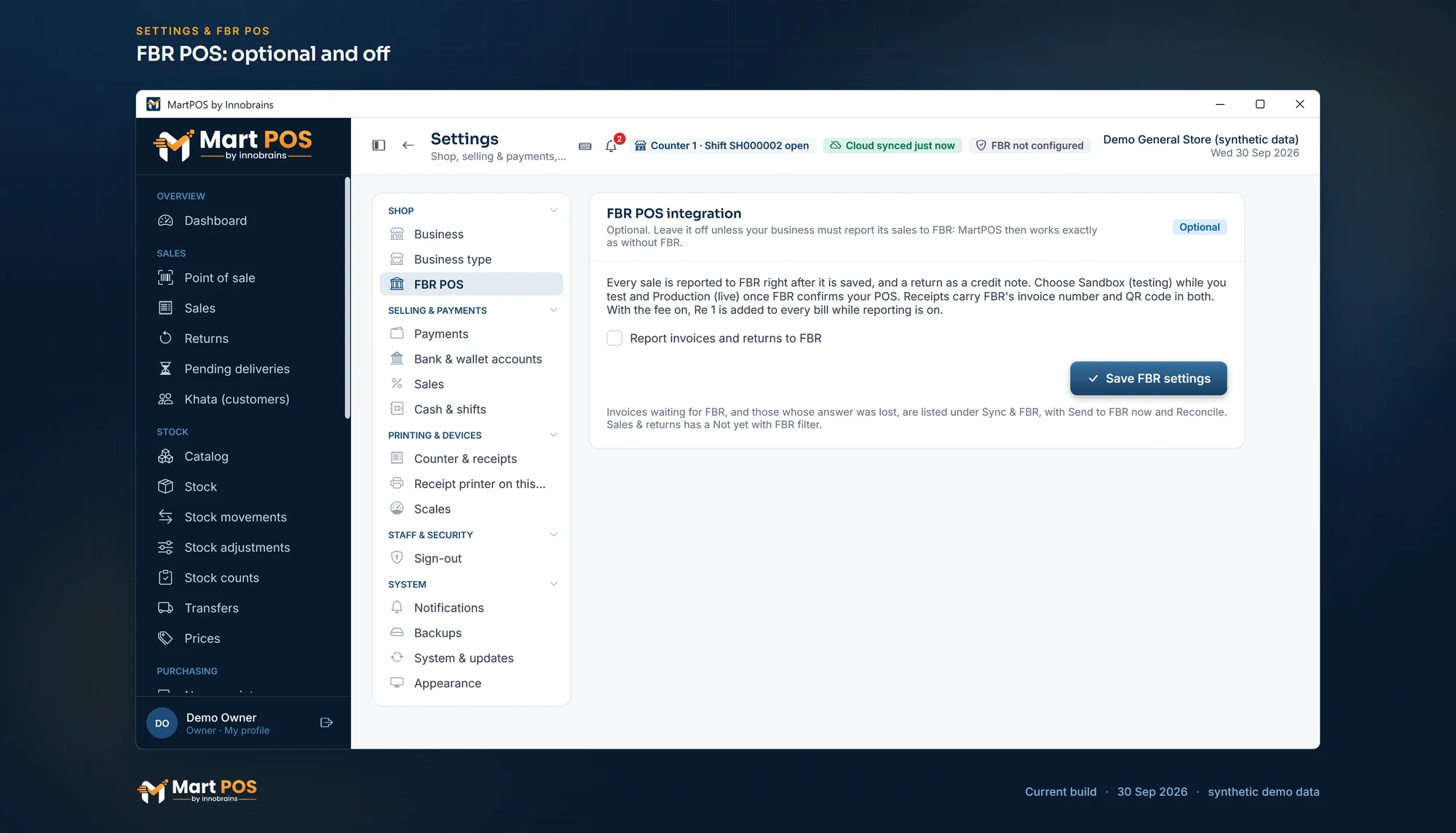
FBR POS: optional and off. Off unless the shop switches it on; receipts then stay ordinary sales receipts. Screenshot of MartPOS (30 Sep 2026) with sample shop data.
Sources
- FBR, POS legal provisions, including SRO 1279(I)/2021 (the Re 1 service charge)
- Sales Tax Act 1990, updated to 2025-26, section 2(43A): FBR PDF
- Finance Act 2026 (Gazette of 26 June 2026), section 2(43A), section 33 and section 64D: FBR PDF
- Sales Tax Rules 2006, Chapter XIV (SRO 69(I)/2025), rules 150R and 150XF: FBR PDF
- FBR POS booklet, May 2025, rule 150XC (offline invoices): FBR PDF
- FBR, Fiscalization solution for retailers (FBR's program on the POS computer, which it calls the Fiscal Data Controller, and its online API)
- FBR, POS invoice verification
Checked on 7 October 2026. Rules change with each budget and SRO: confirm the latest position with FBR or your tax adviser before acting. Vendors' prices are as published on their own websites that day, as linked above. All product names are trademarks of their owners.
Common questions
How much does FBR POS integration cost?
It depends on the route. FBR charges Re 1 per invoice issued through an integrated POS. PRAL's integration services are free of cost on demand under FBR's rules. POS vendors either include it in their price or sell it as an add-on: on 7 October 2026, from no extra charge to PKR 20,000. On top come the PC, a printer that prints QR codes, a UPS, and anything FBR requires of your shop, such as card payments or CCTV.
Is PRAL integration free?
Rule 150XF of the Sales Tax Rules says PRAL shall provide integration services free of cost on demand. The software you bill with, your PC and your printer are still yours to pay for.
Does a small kiryana store need FBR POS integration?
Only if FBR classes it as Tier-1: part of a chain, in an air-conditioned mall or plaza, more than Rs 1.2 million of electricity in twelve months, more than Rs 200 million of turnover, or notified by the Board. A shop that meets none of the tests has nothing to integrate. Confirm with your tax adviser.
Can I add FBR POS integration to the software I already have?
Only if your software can send invoices to FBR, or its vendor or an outside firm connects it. Ask what it costs, once and every year, and whether offline invoices are sent by themselves. If you are replacing the software anyway, choose one with FBR reporting already in its price.
Does the Re 1 fee come out of my profit?
It should not. It is owed to FBR. In MartPOS, when the fee option is on, it is added to the bill on its own line and kept out of your sales and profit. Ask your tax adviser how it should be deposited.
Founder & CEO, Innobrains Technologies
Arshad Ali is the founder and CEO of Innobrains Technologies, the company that makes MartPOS: point-of-sale, stock and khata software for kiryana stores, general stores and mini marts in Pakistan.
Run your shop on MartPOS
Barcode billing, loose goods and packs, khata and advances, on the shop's own PC without internet. We set it up on your shop PC with you.
Related guides
Best kiryana store software in Pakistan (2026): 10 options compared
Which kiryana store software in Pakistan bills without internet, sells loose goods, keeps udhaar khata and costs least over three years? We checked 10 products on their own websites on 7 October 2026: what each does, what it costs in PKR, and who each one suits.
07 Oct 2026 · 15 minMartPOS vs HysabOne: which is better for a kiryana or general store in 2026?
HysabOne is cloud accounting and inventory software with a point-of-sale plan, Urdu screens and phone apps. MartPOS is point-of-sale, stock and khata software for kiryana and general stores that runs on the shop's own Windows PC and is paid once on Desktop. Here is how they compare in PKR and at the counter.
07 Oct 2026 · 11 minMartPOS vs Oscar POS: which is better for a kiryana or general store in 2026?
Oscar is a cloud POS for retail, restaurants and many other businesses, with payments, an online store and loyalty, but no published price. MartPOS is built only for kiryana stores, general stores and mini marts, publishes its PKR prices and runs on the shop's own Windows PC. Here is how they compare for a grocery counter.
07 Oct 2026 · 11 min